Before you start reading
3 beginner questions
New readers often need a few careful distinctions before Daoist wisdom, Yi Ching, Yin-Yang, and Five Elements feel trustworthy. Start here for plain answers and responsible boundaries.
Quick map
These answers are intentionally simple. The goal is not to settle every scholarly debate, but to give beginners enough clarity to use the site without confusion, fear, or false expectations.
3 beginner questions
4 beginner questions
3 beginner questions
2 beginner questions
Daoism can refer to philosophical traditions, religious traditions, ritual communities, cultivation practices, and later historical schools. Eastern Elements does not claim to represent every Daoist lineage or temple tradition.
This site mainly uses Daoist philosophical vocabulary and classical Chinese pattern language for cultural learning, self-reflection, and daily practice.
Review the source mapBoth spellings point to the same Chinese word: dao. Tao is the older Wade-Giles spelling familiar to many English readers, while Dao is the standard pinyin spelling used in modern academic and Chinese-language contexts.
Eastern Elements uses both when helpful for search and reader familiarity, but the concept is the same: the Way, path, course, or pattern by which things move.
Read Tao vs DaoNo. The Tao Te Ching is a compact classical text concerned with Dao, De, non-forcing action, simplicity, governance, humility, and returning to the root.
Eastern Elements reads it as a source for reflection and practice, not as a prediction system.
Read the overviewNo. The free reading is a personal mirror, not a verdict. It uses birth-date pattern language to suggest themes of temperament, timing, and balance.
A useful reading should help you notice one small pattern more clearly. It should not replace your judgment or decide your life for you.
Start free readingThe Yi Ching and Daoism are not the same thing. The Yi Ching is an older Book of Changes tradition built around hexagrams, lines, images, and changing situations.
Daoist thinkers and later Chinese traditions interacted with Yi Ching language, but Eastern Elements keeps the distinction visible: Yi Ching pages are reflection images for timing and conduct, not mechanical certainty.
Read the Yi Ching guideNot exactly. They can be used as reflective language for tendencies, but their deeper value is process: balance, alternation, phases, interaction, and context.
Eastern Elements avoids turning them into rigid identity boxes. The same person can show different elemental movements in different situations.
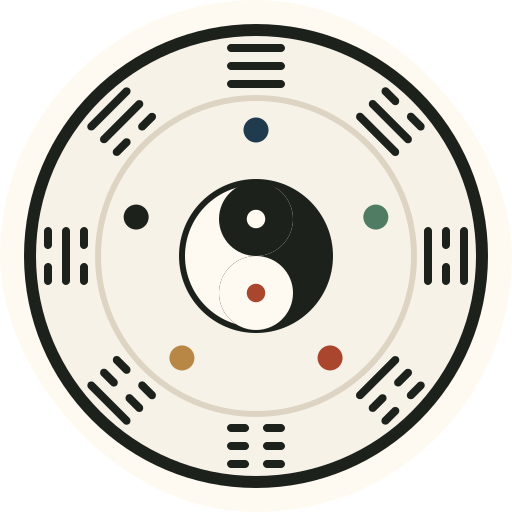
Read Five ElementsYin-Yang is a way of reading paired movement: rest and activity, hidden and visible, receiving and expressing, returning and rising.
It is not a superstition or a fixed personality label. On Eastern Elements, Yin-Yang is the first pattern language for noticing how change moves before it becomes Five Elements, Yi Ching reflection, or daily practice.
Read Yin-YangWu Wei is often translated as non-forcing or effortless action, but it does not mean passivity. It means acting with the grain of the situation instead of adding unnecessary pressure.
In daily life, it can mean waiting one more breath, removing friction, choosing the right timing, or doing the smaller cleaner action.
Read Wu WeiUse the short path: take one free reading, read one Dao concept, and try one practice. Do not try to understand every system at once.
The site is designed so you can enter through Reading, Library, or Practice and still return to the same foundation.
Start hereNo. Eastern Elements is for cultural learning and personal reflection. It is not medical, psychological, legal, financial, or emergency advice.
For serious health, safety, money, legal, or mental-health concerns, use qualified professional support.
Read disclaimerThe project is still in validation. Early interest helps decide which materials are worth preparing carefully before payment, fulfillment, or inventory is added.
This keeps products secondary to the learning path instead of pushing a premature checkout.
View report planThe public Library should remain useful. A future ebook can gather the fuller reading path into a polished, coherent edition with manuscript context, modern reflections, and small practices.
The goal is a serious independent digital edition, not a collection of vague quotes.
View Tao Te ChingThe best first visit is small: clear one misunderstanding, take one reading or read one concept, and try one practice without making the whole tradition into a fixed label.