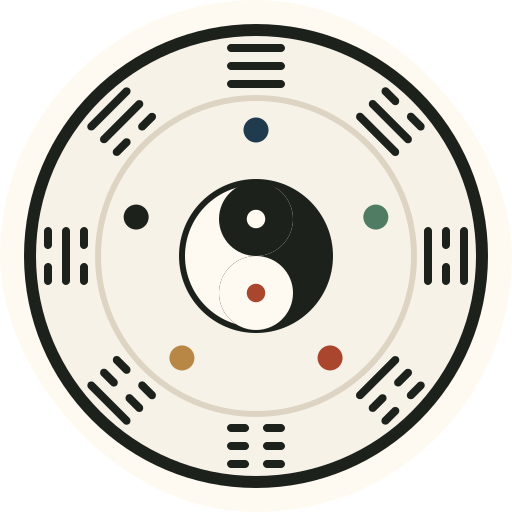
Start with the classical record
Pages begin from classical Chinese texts, manuscript context, and early interpretive traditions before they become modern explanations.
Dao De Jing, Book of Changes, Laozi manuscript contextEastern Elements is built from Dao outward. The site uses Daoist language, Tao Te Ching manuscript context, Yi Ching imagery, Yin-Yang, and Five Elements as reflective pattern language for modern life, while keeping claims modest and sources visible.
The site is not trying to prove fate, sell certainty, or present ancient terms as decoration. Its method is simpler: begin with the textual and philosophical record, explain the idea in plain English, and offer one modest way to reflect or practice.
Source standards
This gives the Library a repeatable standard. Every new topic should pass through a source layer, a context layer, a modern explanation, and a boundary layer before it becomes a public-facing page.
Pages begin from classical Chinese texts, manuscript context, and early interpretive traditions before they become modern explanations.
Dao De Jing, Book of Changes, Laozi manuscript contextThe site checks broad concepts against scholarly encyclopedias, library records, and established reference pages where available.
SEP, IEP, Library of Congress, Chinese Text ProjectModern writing is allowed to be warm and practical, but it should preserve uncertainty, metaphor, and the limits of translation.
Quick answers, practice notes, reflective readingsA source-based page should never turn classical language into guaranteed luck, fixed fate, medical advice, or pressure to buy.
No fixed-destiny claims, no fear-based conversion copySource anchors
This is not a complete bibliography. It is the public source map: the texts and ideas that keep the site grounded while the writing remains readable for modern Western visitors.
The project begins with Daoist vocabulary as a way to speak about natural movement, non-forcing action, cultivated integrity, and returning to balance.
Stanford Encyclopedia of PhilosophyDaoist philosophyDaoism is treated as a long tradition of thought and practice, not as a single mood, slogan, or simplified lifestyle aesthetic.
Internet Encyclopedia of PhilosophyLaozi contextLaozi is handled as both a textual title and a traditional figure, with attention to how the Daodejing has been transmitted and interpreted.
Internet Encyclopedia of PhilosophyTao Te Ching textThe Tao Te Ching material is checked against classical-text records before being rewritten as beginner-friendly modern reading.
Chinese Text ProjectTao Te Ching editionMawangdui and Guodian matter because they remind readers that the Laozi / Tao Te Ching has a transmission history, not a single frozen English slogan.
Library of CongressMawangdui contextMawangdui matters because it reminds readers that the Laozi / Tao Te Ching has a transmission history, not a single frozen English slogan.
Stanford Encyclopedia of PhilosophyYi ChingYi Ching pages treat hexagrams as reflective images for timing and conduct. The site avoids presenting them as mechanical certainty about the future.
Chinese Text ProjectYin-YangYin-Yang is used as language for relational movement, alternation, and harmonization rather than a rigid personality type.
Internet Encyclopedia of PhilosophyFive ElementsWood, Fire, Earth, Metal, and Water are treated as phase language for tendencies, cycles, and balance, not as guaranteed outcomes.
Stanford Encyclopedia of PhilosophyEditorial method
The writing method is deliberately restrained. Each concept should move from source language to modern explanation to one practical reflection, with clear boundaries around what the site can and cannot do.
A page should point back to Daoist vocabulary, Tao Te Ching context, Yi Ching imagery, Five Elements language, or seasonal practice before offering modern interpretation.
The goal is clarity without flattening. A useful explanation should preserve uncertainty, metaphor, and the limits of translation.
A strong page should leave the reader with one modest way to notice timing, reduce force, journal, breathe, or adjust daily rhythm.
Reports, ebooks, audio, and symbolic goods should support learning and practice. They should not become the center of the tradition.
Reader path
The sources are here to create trust and orientation. Readers who want a practical next step can move from this map into the main Library, the Tao Te Ching path, Yi Ching reflection, or the free reading.
Begin with Dao as the root language behind the site.
Primary textRead the Mawangdui-oriented Tao Te Ching pathway.
Reflective structureUse hexagrams as images for timing and conduct.
Personal entryTry the free reading as a practical doorway into the same pattern language.
Boundaries are not a legal afterthought. They are part of the brand: a serious Daoist wisdom site should help readers notice patterns without taking away responsibility, judgment, or professional care.
No. Eastern Elements is an independent cultural and reflective project. It uses classical and academic references as anchors, then rewrites ideas in plain English for modern readers.
Mawangdui is useful because it reminds readers that the Laozi / Tao Te Ching has a textual history. That keeps the project away from treating one English wording as the only possible meaning.
No. Yi Ching and Five Elements pages are framed as reflective pattern language for timing, conduct, and self-observation, not as fixed-destiny prediction.
The exercises are small ways to notice rhythm, force, balance, and attention. They are not medical, psychological, legal, or financial advice.
Yes. As the Library grows, this page should become a living source map that records the texts, institutions, and editorial boundaries behind new pages.
Begin with the foundation if you want context, or use the free reading if you want a personal entry point into the same pattern language.