Where the concept touches the text
Chapter 42
万物负阴而抱阳,冲气以为和。
The ten thousand things bear yin, embrace yang, and harmonize through qi.
Conceptual caution
气
Qi should be read in its classical Chinese conceptual setting rather than forced into a single modern category.
Keep these distinctions clear
Breath and vitality
Qi often points to breath-like vitality or energetic process.
Cosmological language
In Daoist and broader Chinese thought, qi helps describe how things are constituted and transformed.
Not a medical claim here
Eastern Elements does not diagnose, heal, or measure qi.
Pattern language
On this site, qi is used to speak about rhythm, relation, balance, and cultivation.
Qi is broader than "energy"
Many English readers translate qi as energy. That can be useful at first, but it can also be misleading. Qi is a broad term whose meaning shifts across philosophy, medicine, cosmology, martial arts, and religious practice.
For Eastern Elements, qi is used carefully as cultural pattern language: breath, vitality, movement, relation, and the felt condition of a situation.
Do not force qi into modern physics
The site should not claim that qi is a measurable physical substance in the modern scientific sense. It should also not dismiss it as meaningless metaphor.
A rigorous middle path treats qi as a historically important Chinese concept that helps organize practices of body, world, timing, and transformation.
How qi supports the reading tool
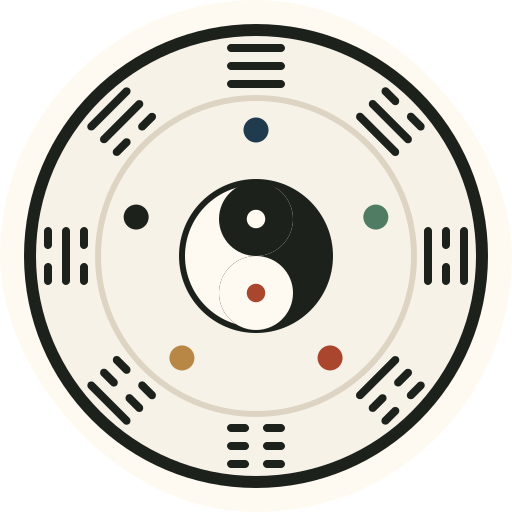
When the reading tool says a pattern carries Wood, Fire, Earth, Metal, or Water qi, it is not measuring destiny. It is offering a vocabulary for movement: growth, brightness, grounding, refinement, and depth.
That vocabulary is useful only when it leads to better attention and more responsible choices.
Try it without making it heavy
Take three quiet breaths and notice the state of the body.
Name the dominant quality of the moment: tense, open, scattered, heavy, bright, or still.
Choose one small adjustment that changes the quality without forcing a dramatic result.
Questions to keep close
- What is the felt quality of this situation?
- Which movement would bring more balance?
- Where am I using "energy" language too loosely?