A Dynamic Pair
Yang is often associated with brightness, activity, warmth, expression, height, and outward movement. Yin is associated with shade, rest, coolness, containment, depth, and inward return.
The two words are relational. A morning can be Yang compared with midnight, but Yin compared with noon. A quiet person may feel Yin in a noisy room and Yang in a place of complete stillness. The point is not a fixed label; the point is the relationship between qualities.
Balance Is Not Stillness
In classical Chinese thought, balance is alive. Day becomes night, effort needs recovery, and strong action needs quiet listening. If one side grows to an extreme, it naturally begins to turn toward the other.
This is why Yin-Yang thinking is useful for modern life. It asks us to notice rhythm. Are you pushing when the moment asks for restoration? Are you waiting when the moment asks for action?
Yin-Yang And The Body Of A Day
A simple way to understand Yin-Yang is to watch a day. Dawn rises, activity grows, light peaks, then the afternoon begins to soften. Evening gathers the world inward. Night restores what daylight spends.
This daily cycle turns an abstract symbol into an observable pattern. It gives beginners a grounded way to think about work, rest, speech, attention, and decision-making.
How To Use It
Yin-Yang can become a practical reflection tool. Ask where you are overextended, where you are too withdrawn, and what kind of small adjustment would restore a better exchange.
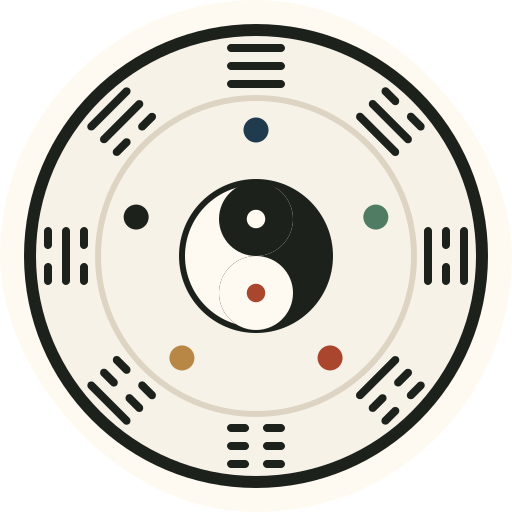
For this site, Yin-Yang is also the foundation beneath the Five Elements and the Eight Trigrams. Before reading symbols, we learn to see polarity, rhythm, and transformation.
This also keeps the practice grounded. Instead of asking whether a person is simply Yin or Yang, the better question is where the relationship between the two has become strained, neglected, or ready to shift.
Continue through the closest related questions.
These links connect the foundation article to the next search-friendly pages, so a new reader can move from definition to comparison, responsible use, and a practical first step.
Read the overview with its anchors visible.
This page is a beginner doorway, so it keeps the deeper sources close: external scholarly references, the site source map, and related internal paths.
Everyday example
Imagine a week filled with meetings, decisions, and outward activity. A Yin-Yang reading would not say that activity is bad. It would ask whether the Yang side has grown without enough Yin return: sleep, quiet, listening, and reflection.
The balancing move may be small. Close the day without one more task, delay a reply until morning, or create a quieter hour before making a decision. The point is not withdrawal from life, but restoring exchange between effort and recovery.
Terms to keep close
Complementarity
Yin and Yang complete each other. One side gives meaning to the other.
Alternation
The pattern moves. Day changes into night; rest prepares action.
Relativity
Nothing is Yin or Yang in isolation. It depends on the comparison.
Mutual restraint
Each side keeps the other from excess and helps restore rhythm.
Historical notes
Yin-Yang language became central in early Chinese cosmology as thinkers described weather, seasons, health, politics, ritual, and human conduct through patterned change.
Later traditions connected Yin-Yang with the Five Elements, the calendar, the Yi Ching, medicine, and cultivation. The idea grew into a shared vocabulary for reading change.
Today it is most helpful when treated as reflective language: a way to notice excess, deficiency, timing, and the need for adjustment.
Common beginner questions
What does Yin-Yang mean in simple terms?
Yin-Yang means complementary qualities that define and transform each other. Yin can suggest shade, rest, coolness, depth, and receiving. Yang can suggest brightness, activity, warmth, expression, and outward movement.
Is Yin bad and Yang good?
No. Yin and Yang are not a moral hierarchy. Both can be healthy, excessive, depleted, or timely depending on the relationship and situation.
Is Yin-Yang about balance?
Yes, but balance here means living exchange. Day turns toward night, effort needs recovery, and strong action needs quiet listening. Balance changes with timing.
How is Yin-Yang connected to the Five Elements?
Yin-Yang gives the basic language of polarity and alternation. The Five Elements then describe five recurring movements of change: Wood, Fire, Earth, Metal, and Water.