Five Movements, Not Five Boxes
Wood points to growth, direction, planning, and renewal. Fire points to expression, visibility, warmth, and enthusiasm. Earth points to stability, nourishment, mediation, and trust.
Metal points to refinement, structure, boundaries, and discernment. Water points to depth, adaptability, memory, and flow. These are symbolic movements, not personality cages.
The Generating Cycle
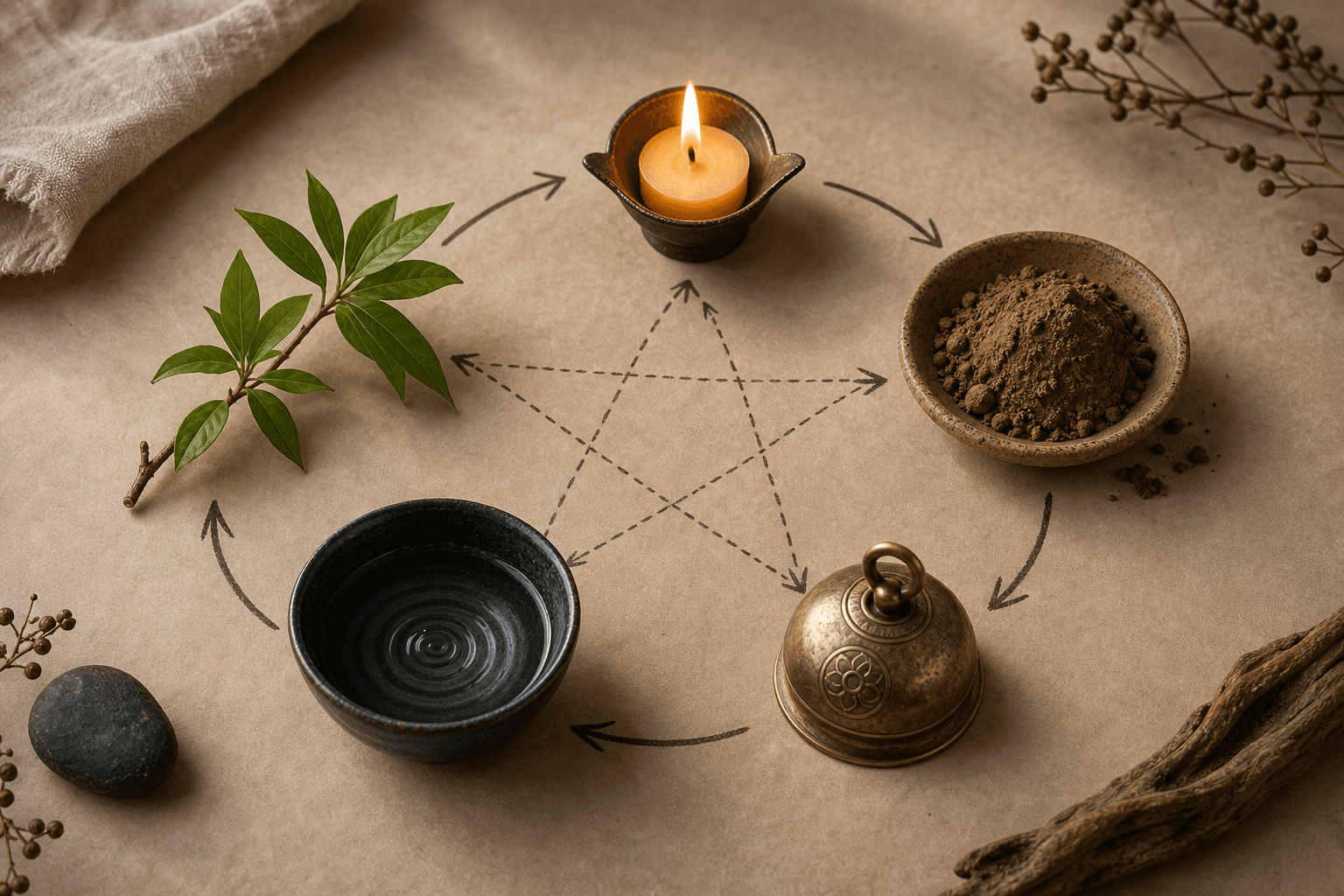
The generating cycle describes support: Wood feeds Fire, Fire creates ash that enriches Earth, Earth bears Metal, Metal enriches Water in traditional imagery, and Water nourishes Wood.
As a reflection tool, this cycle asks what helps a quality grow. A plan may need encouragement. Enthusiasm may need grounding. Structure may need quiet depth before it becomes wise.
The Regulating Cycle
The regulating cycle describes restraint and balance. Wood parts Earth, Earth contains Water, Water cools Fire, Fire melts Metal, and Metal cuts Wood.
This is not a cycle of attack. It is a way to describe healthy limits. Too much Fire may need Water. Too much Wood may need Metal. Too much Earth may need movement.
Seasons And Human Rhythm
The Five Elements are often connected with seasonal images: Wood with spring, Fire with summer, Earth with transition and late summer, Metal with autumn, Water with winter.
These seasonal associations make the system easy to feel. We grow, bloom, gather, refine, and store. A person can use the pattern to reflect on work cycles, creative projects, relationships, and rest.
Why It Matters Here
Our free reading uses the Five Elements as an accessible doorway into Eastern pattern thinking. It gives users a first map of natural strengths, missing elements, and possible cultivation themes.
The best use is not to ask, "Which element am I forever?" A better question is, "Which movement is strong now, and which movement needs support?"
This is also why element language can feel useful without becoming fatalistic. A person may carry a strong elemental tendency and still cultivate the missing movement through habits, environment, relationships, and timing.
Three distinctions make the Five Elements easier to use.
Many readers arrive from practical questions about Chinese elements, Yin-Yang, Bagua, or personal readings. These links keep the path clear: first understand the model, then apply it gently.
What are the Five Elements?
Wood, Fire, Earth, Metal, and Water are better read as five movements of change. They describe growth, expression, stability, refinement, and return.
Try the readingConcept bridgeHow do Wu Xing and Yin-Yang fit together?
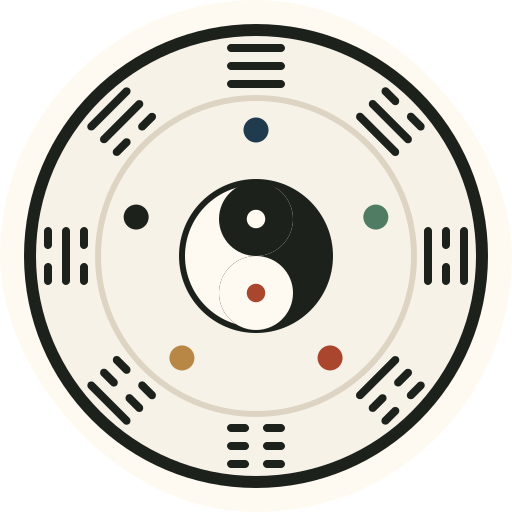
Yin-Yang gives the language of polarity and alternation. Wu Xing adds a five-phase cycle for how qualities support, regulate, and transform.
Read Yin-YangClarificationIs Bagua the same as Five Elements?
No. Bagua belongs to the Eight Trigrams and Yi Ching symbolic system. Five Elements is a related but different pattern language.
Read Eight TrigramsUse the free reading as a mirror, not a verdict.
The reading page turns the same Wu Xing language into a personal reflection path. It is designed for self-observation, not fixed fate, guaranteed outcomes, or professional advice.
Learn the model
Start with the five movements and the two cycles so the terms do not feel like mystical labels.
Read your pattern
Use the free preview to place Wood, Fire, Earth, Metal, and Water beside a birth-date based reflection.
Choose one small practice
The useful question is not what you are forever, but what kind of balance would help this week.
Study each movement separately
Each element can be read as a daily pattern: how energy begins, shines, holds, refines, or returns. These profiles connect the Five Elements guide with the free reading result path.
Continue through the closest related questions.
These links connect the foundation article to the next search-friendly pages, so a new reader can move from definition to comparison, responsible use, and a practical first step.
Read the overview with its anchors visible.
This page is a beginner doorway, so it keeps the deeper sources close: external scholarly references, the site source map, and related internal paths.
Everyday example
A creative project may begin with strong Wood: ideas, plans, sketches, and forward direction. It may then need Fire to be shared, Earth to become repeatable, Metal to be edited, and Water to rest before the next cycle.
When users see a missing or weak element in a reading, the best question is not how to fix a defect. A gentler question is which movement would make the current situation more complete: more structure, more warmth, more patience, more renewal, or more quiet depth.
Terms to keep close
Wood
Growth, vision, spring energy, direction, and renewal.
Fire
Warmth, expression, summer energy, visibility, and connection.
Earth
Grounding, nourishment, transition, reliability, and care.
Metal
Refinement, boundaries, autumn energy, standards, and discernment.
Water
Depth, winter energy, adaptability, listening, and restoration.
Historical notes
The Five Elements became a major organizing idea in classical Chinese correlative thought, linking seasons, directions, colors, sounds, governance, medicine, and ritual language.
Although the English word "elements" is common, "phases" or "movements" often explains the idea better. Wu Xing is about process.
On this site, the model is used as reflective and educational language, not as medical diagnosis or guaranteed prediction.
Common beginner questions
What are the Five Elements in Chinese philosophy?
The Five Elements are Wood, Fire, Earth, Metal, and Water. In Wu Xing thought they are best understood as five phases, movements, or modes of change rather than five static materials.
Is Five Elements the same as personality typing?
No. The system can describe tendencies, but Eastern Elements uses it as reflective process language. A person, project, relationship, or season can show several elemental movements at once.
What is the generating cycle?
The generating cycle describes support: Wood feeds Fire, Fire enriches Earth, Earth bears Metal, Metal enriches Water in traditional imagery, and Water nourishes Wood.
What is the regulating cycle?
The regulating cycle describes balance through restraint: Wood parts Earth, Earth contains Water, Water cools Fire, Fire melts Metal, and Metal cuts Wood. It is better read as healthy limiting, not attack.
How should a beginner use a Five Elements reading?
Use it as a mirror. Ask which movements are strong, which are quiet, and what small practice could restore balance. It should not replace judgment, medical advice, or life decisions.
How do the Five Elements affect daily life?
They offer language for rhythm and balance. Wood can describe growth and planning, Fire expression, Earth steadiness, Metal boundaries, and Water rest or depth. The point is to notice which movement a situation may need.
How do Wu Xing and Yin-Yang work together?
Yin-Yang describes paired qualities such as activity and rest or expansion and return. Wu Xing adds five recurring movements that show how qualities support, regulate, and transform one another.
Is Bagua the same as the Five Elements?
No. Bagua means the Eight Trigrams and belongs most directly to Yi Ching symbolism. The Five Elements are a separate but related system for describing phases of change.