Lines Before Symbols
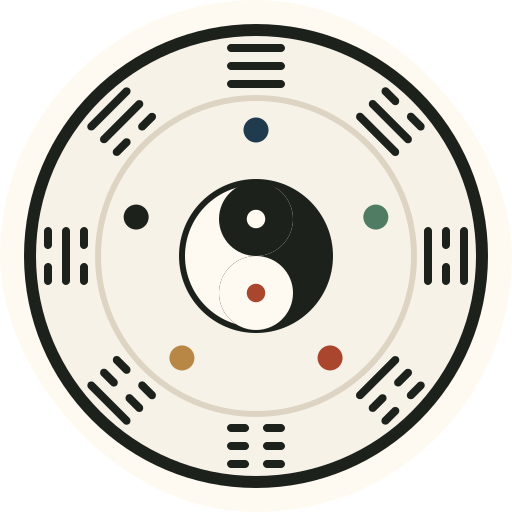
A solid line is usually read as Yang: firm, active, clear, and continuous. A broken line is usually read as Yin: receptive, open, yielding, and responsive.
Read line positions from the bottom upward. Qian (Heaven) is the simplest example: all three lines are unbroken Yang lines.
Each trigram is made of three lines. With only two kinds of lines, the tradition creates eight compact images. This simplicity is part of its power.
Images From Nature
Heaven, Earth, Thunder, Wind, Water, Fire, Mountain, and Lake are not decorative labels. They are compact images for force, receptivity, movement, penetration, danger, clarity, stillness, and joy.
The images help a reader ask what kind of change is present. Is a situation rising like Thunder, settling like Mountain, spreading like Wind, or clarifying like Fire?
Reading A Situation
A trigram can describe the shape of a moment. Heaven may suggest creative force. Earth may suggest openness and support. Water may suggest depth and risk. Lake may suggest ease, exchange, and delight.
This is reflective language, not a guaranteed prediction. It gives the mind a set of images for careful interpretation.
A Bridge To The Yi Ching
The Yi Ching combines trigrams into hexagrams, each with six lines. A hexagram can be read as two trigrams in relation: inner and outer, lower and upper, present condition and emerging pattern.
Understanding the Eight Trigrams gives readers a calmer foundation before they approach more complex classical symbolism.
For beginners, the most helpful step is not memorizing every correspondence. It is learning to read a trigram as an image: force, receptivity, awakening, gradual influence, depth, clarity, stillness, or joyful exchange.
Bagua, Yin-Yang, And Five Elements
Bagua belongs first to the trigram language: three stacked Yin or Yang lines become a natural image. Yin-Yang supplies the line logic, while Bagua arranges those lines into eight symbolic patterns.
The Five Elements are a related but different layer. Wood, Fire, Earth, Metal, and Water describe phases and cycles of transformation. Later traditions may connect trigrams and elements, but a careful beginner path should not collapse them into one list.
A simple order helps: learn Yin-Yang as polarity, Bagua as image, Wu Xing as phase, and Yi Ching hexagrams as situations in motion.
Do not flatten Bagua, Yin-Yang, and Wu Xing into one list.
Many new readers meet these terms together and assume they are interchangeable. A clearer path keeps the layers separate first, then shows how later traditions can connect them.
Yin-Yang makes the lines
A solid Yang line and a broken Yin line are the smallest units. Three lines become one trigram image.
Review Yin-YangImage layerBagua is the eight-trigram map
Bagua is not only a decorative diagram. It names eight images of change: Heaven, Earth, Thunder, Wind, Water, Fire, Mountain, and Lake.
Continue to Yi ChingPhase layerWu Xing is related, not identical
The Five Elements describe phases and cycles. They can be connected to trigram traditions, but beginners should not collapse them into one system.
Compare Five ElementsStart from line, image, and relation.
The Eight Trigrams become useful when they slow interpretation down. Instead of rushing to a result, the reader learns to name the kind of movement in the situation.
Read the line quality
Notice whether the symbol is built from firm Yang lines, open Yin lines, or a changing mixture.
Read the natural image
Let Heaven, Earth, Thunder, Wind, Water, Fire, Mountain, or Lake name the quality of movement.
Read the relation
When two trigrams form a hexagram, ask how inner condition and outer situation are meeting.
Continue through the closest related questions.
These links connect the foundation article to the next search-friendly pages, so a new reader can move from definition to comparison, responsible use, and a practical first step.
Read the overview with its anchors visible.
This page is a beginner doorway, so it keeps the deeper sources close: external scholarly references, the site source map, and related internal paths.
Everyday example
If a conversation suddenly changes direction, Thunder may be a useful image: something has awakened and the room has more charge than before. If the best response is to pause and stop adding force, Mountain may be the wiser image.
The trigrams help a reader name the movement before choosing a response. They are less like labels for people and more like weather signs for a situation.
Terms to keep close
Qian / Heaven
Creative force, initiative, strength, and continuity.
Kun / Earth
Receptivity, support, nourishment, and capacity.
Zhen / Thunder
Arousing movement, awakening, shock, and new momentum.
Xun / Wind
Gentle penetration, influence, flexibility, and gradual entry.
Kan / Water
Depth, danger, hidden truth, endurance, and flow.
Li / Fire
Clarity, illumination, beauty, dependence, and visibility.
Gen / Mountain
Stillness, boundary, pause, and inner restraint.
Dui / Lake
Joy, exchange, openness, speech, and shared ease.
Historical notes
The trigrams are part of the symbolic grammar behind the Yi Ching. They turn Yin-Yang lines into natural images and relational patterns.
Different arrangements, often called earlier-heaven and later-heaven sequences, are used in different interpretive traditions. Beginners do not need to master them immediately.
For an international audience, the trigrams are best introduced as a visual language of change before adding advanced applications.
Common beginner questions
What are the Eight Trigrams in simple terms?
The Eight Trigrams are eight three-line symbols made from Yin and Yang lines. Each one points to a natural image and a style of change, such as Heaven, Earth, Thunder, Wind, Water, Fire, Mountain, or Lake.
How are the Eight Trigrams connected to the Yi Ching?
The Yi Ching combines trigrams into sixty-four hexagrams. A hexagram can be read as two trigrams in relationship: lower and upper, inner and outer, condition and response.
Are the Eight Trigrams the same as Bagua?
Yes. Ba Gua or Bagua literally points to the eight trigrams. The term is often seen in diagrams, but the deeper value is the disciplined reading of line, image, relation, and timing.
Is Bagua the same as Wu Xing or the Five Elements?
No. Bagua refers to the Eight Trigrams, a symbolic system made from Yin and Yang lines. Wu Xing, or the Five Elements, describes five phases of change: Wood, Fire, Earth, Metal, and Water. They can be related in later traditions, but they are not the same system.
How do Yin-Yang, Bagua, and the Yi Ching fit together?
Yin-Yang gives the two line qualities. The Eight Trigrams combine three lines into eight natural images. The Yi Ching combines two trigrams into each six-line hexagram and reads the relation between them.
Should beginners memorize every trigram correspondence?
No. It is better to start with the main image of each trigram. Learn what Heaven, Earth, Thunder, Wind, Water, Fire, Mountain, and Lake feel like as patterns of change.